Drain Cleaning Work and Honolulu Inspection Requirements
Drain cleaning sounds simple until it crosses the line from routine maintenance into regulated plumbing work. That line matters in Honolulu. It affects who should perform the work, whether a permit may be involved, and when an inspection becomes part of the job.
Homeowners and property managers often start with a practical question: do I need a plumber for this drain problem, or can any drain service handle it? In Hawaii, that question is not just about convenience or price. It is tied to licensing rules, permit obligations, and the city’s inspection process for work that falls under plumbing and drainage. If you are hiring a plumber Honolulu residents can trust, or searching online for a plumber near me because a kitchen line backed up late at night, it helps to know where ordinary cleaning ends and regulated plumbing work begins.
The most important point is straightforward. Plumbing work in Hawaii is regulated by the state Department of Commerce and Consumer Affairs. Consumers can verify a plumber’s license status, expiration date, and disciplinary history through the official license search tools. The state also makes clear that electrical and plumbing contractors must employ licensed electricians and plumbers to perform the actual electrical or plumbing work. Honolulu adds another layer through its plumbing code and permitting system, which requires inspection of plumbing and drainage work that is authorized by permit.
That framework shapes how drain cleaning should be approached in real life.
Why drain cleaning is not always just a maintenance call
A lot of service calls begin the same way. A shower is slow. A floor drain smells bad. A kitchen sink gurgles whenever the dishwasher runs. In many homes, a first response might be a basic cleaning, snaking, or clearing of localized buildup. On its own, that may not sound like a construction project. But drain symptoms can be signs of something larger, and the moment the work moves into plumbing system alteration, repair, or other permit-triggering activity, the legal and inspection requirements change.
This is where experience matters. A seasoned plumber Oahu property owners rely on will not treat every clog as identical. One backup could be grease in a branch line. Another could suggest a deeper defect that eventually leads to sewer line repair. A recurring stoppage could point toward misalignment, deterioration, or another condition that basic cleaning will not solve. The trade judgment is in recognizing when the call is a straightforward service matter and when it has become code-governed plumbing work.
That distinction protects the customer. It also protects the building. Drainage systems are hidden infrastructure. If the work is done poorly, the signs may not show up right away. Instead, problems return in weeks or months, often with more damage and more cost.
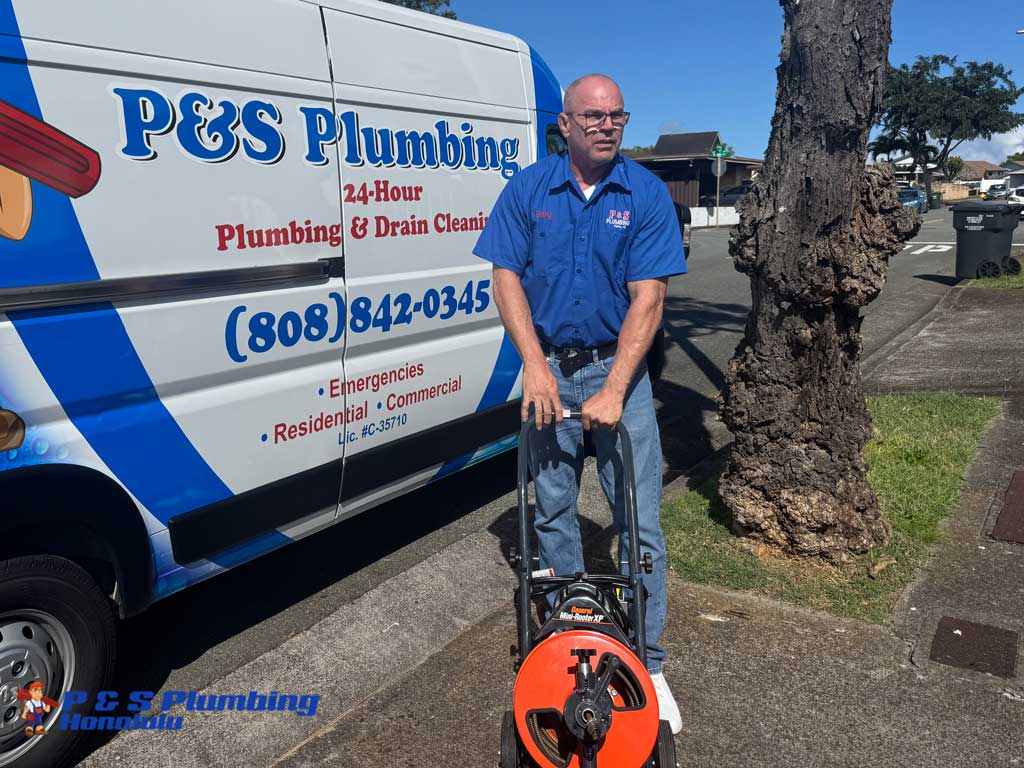
The licensing piece comes first
Before getting into permits or inspections, start with the person or company doing the job. Hawaii regulates plumbing work through the state. Consumers can check whether a plumber is licensed, whether the license is current, and whether there is disciplinary history on record. That is not a formality. It is one of the most useful screening steps a customer can take.
State guidance also says that electrical and plumbing contractors must employ licensed electricians and plumbers to perform the actual electrical or plumbing work. That matters in the drain cleaning space because some companies market themselves broadly as clog specialists, maintenance crews, or all-purpose repair services. If the work being performed is actually plumbing work, the labor should be done by the properly licensed trade professional.
There is also a threshold issue many owners overlook. State guidance advises hiring a licensed contractor for projects over $1,500 in labor and materials, or for any project needing a building, electrical, or plumbing permit. A job does not have to be huge to pass that threshold. Once drain problems lead to more extensive corrective work, costs can climb quickly. What started as a service call can turn into a repair project.
For commercial properties, the stakes are usually higher. A commercial plumber often works under tighter operational constraints, around health standards, tenant demands, and downtime concerns. If a restaurant, apartment building, or retail site has drainage trouble, the owner cannot afford to guess about whether licensed plumbing work is involved.
What Honolulu requires when a permit is involved
Honolulu’s plumbing code states that plumbing and drainage work authorized by permit is inspected for compliance. That sentence carries a lot of weight. It means inspection is not an optional courtesy when permitted plumbing work is taking place. It is part of the compliance process.
Honolulu’s permitting guidance also notes that all electrical and plumbing work must be performed by contractors licensed by the State of Hawaii. That aligns with the state’s licensing rules and reinforces the city’s expectation that regulated work be done by properly credentialed professionals.
The practical takeaway is this: if a drain cleaning call turns into permit-authorized plumbing or drainage work, expect inspection to be part of the job. The purpose of that inspection is code compliance. It is there to confirm that the authorized work meets the applicable standards, not just that water seems to be flowing again when the technician leaves.
People sometimes assume inspections are only for major remodels or brand-new construction. In reality, inspection obligations follow the permit, not the homeowner’s opinion of job size. A repair can be disruptive, expensive, and important even if it is confined to one line in one part of the building.
The gray area homeowners ask about most
The confusion usually comes from mixed service categories. “Drain cleaning” can describe several very different situations. At one end, it means removing a localized obstruction so fixtures drain properly again. At the other end, it becomes part of a larger plumbing intervention involving repair, replacement, or permit-driven corrective work. Most customers do not call with code language in mind. They call because water is not going where it should.
In the field, you often see three common misunderstandings.
First, people assume that if the technician uses cleaning equipment rather than installing new pipe, the job is outside plumbing regulation. That is not a safe assumption. The legal significance depends on the actual scope of work, not just the tool used on site.
Second, people assume that if a backup is urgent, licensing and permit rules somehow pause. They do not. An emergency plumber may respond quickly, but the work still has to fit state and city requirements.
Third, customers often believe that if they found the company by searching plumber near me and the truck looks professional, the license status must already be in order. Sometimes it is. Sometimes it is not. Verification is still worth doing.
When drain cleaning starts pointing to repair work
Drain cleaning is often the first chapter, not the whole story. A line that clogs once every few years is one thing. A line that stops up repeatedly after being cleared suggests a bigger issue. If the problem is no longer just blockage removal, the scope may shift toward repair.
At that stage, conversations often expand into related services such as sewer line repair or leak detection. Those services are not interchangeable with ordinary cleaning. They speak to system condition, failure points, and sometimes hidden water loss or structural deterioration. Even in homes where the owner originally called about a bathroom drain, the contractor may discover signs that justify a broader evaluation.
A disciplined plumbing professional does not jump to the most expensive answer. Good trade judgment means ruling out the simple causes before proposing larger work. But good judgment also means not pretending a failing system is fine just because a temporary clearing restored flow for a day or two.
I have seen owners spend money three times on repeat clearing because nobody wanted to be the one to say the issue had moved past maintenance. That delay is expensive. It is also frustrating, because every repeat visit interrupts life without delivering a durable result.
Inspection is about compliance, not sales pressure
Some customers get nervous the moment permits and inspections come up. They worry it means the job will be overbuilt, delayed, or padded with unnecessary charges. Sometimes that concern comes from past experiences in other trades. Sometimes it comes from not knowing what the city actually requires.
In Honolulu, the key fact is narrow and important: plumbing and drainage work authorized by permit is inspected for compliance. The inspection is a compliance step tied to the authorized work. It is not a marketing device. It is not there because a contractor wants to complicate a straightforward service call. If a permit is required, the inspection follows from that.
This should actually give owners some comfort. Inspection creates a formal checkpoint. That does not guarantee a perfect experience, but it does mean the work is not existing in a gray zone outside the normal oversight structure.
For property managers and commercial owners, that checkpoint can be especially important. Documentation, accountability, and code compliance have operational value. If there is later a dispute about scope, workmanship, or condition, permitted and inspected work usually stands on firmer ground than undocumented improvisation.
How permit value affects the overall job picture
Honolulu’s permitting guidance notes that permit valuation includes plumbing, heating, air conditioning, and other permanent work when calculating fees. That detail matters because many owners focus only on the visible portion of a drain problem. They see a clogged sink or floor drain. The city looks at the value of the permanent work involved in the permit.
For example, if a drain issue is part of a broader repair effort within a building project, the valuation framework may include multiple permanent systems rather than isolating one symptom. That does not mean every drain cleaning call becomes expensive. It means once the work enters permit territory, the city’s fee calculation is based on more than a narrow service description.
This is one reason experienced contractors try to define scope carefully from the outset. If they suspect the issue extends beyond routine cleaning, they need to explain that early. Customers deserve to understand whether they are buying a maintenance attempt, a diagnosis, or a repair path that may involve permit and inspection requirements.
What to ask before authorizing the work
A short conversation before work begins can prevent a lot of confusion later. The right questions are usually simple.
- Is this call being treated as routine drain cleaning only, or do you expect plumbing repair work may be needed?
- If the scope changes, would that trigger permit requirements or inspection in Honolulu?
- Who will perform the actual plumbing work, and is that person properly licensed in Hawaii?
- If the cost grows past the small-service range, how will you document the revised scope and pricing?
- If you discover a larger system issue, what are the next responsible options rather than just the most expensive one?
Those questions do two things. They help honest contractors explain the boundaries of the job, and they tend to expose vague operators who want maximum flexibility with minimum accountability.
https://chanceagdr890.meridiannest.com/posts/plumber-honolulu-homeowners-can-trust-to-meet-state-requirementsThe role of continuing competency
Licensing is not static. Hawaii currently requires licensed plumbers on active status to show proof of continuing competency in the 2021 Uniform Plumbing Code for the licensing period running from July 1, 2024 to June 30, 2027. For customers, that may sound like a technical administrative detail. In practice, it matters.
Codes evolve. Interpretations sharpen. Materials, accepted practices, and compliance expectations do not stand still forever. A plumber who keeps current is better positioned to recognize when a drain issue is just a stoppage and when it intersects with code-governed work that should be handled more carefully.
There is a contractor licensing calendar as well. Contractor licenses renew by September 30 of every even-numbered year, with on-time renewals for the 2026 to 2028 period accepted from August 10, 2026 through September 30, 2026. For a customer, the lesson is simple: check current status rather than assuming a company that was valid once is still valid now.
Emergency calls change the tempo, not the rules
Drain failures rarely happen on a convenient schedule. A sewer backup at night, a flooded utility area, or a clogged commercial line before business hours creates immediate pressure to act. That is when people search emergency plumber and hope the first available truck can solve everything on arrival.
Speed matters in those situations, but urgency should not erase due diligence. The right move is often to stabilize the problem quickly, then define the permanent work clearly. If the solution ends up involving regulated plumbing work or permit-authorized drainage work, the same licensing and inspection framework still applies.
This is one of the hardest judgment calls in the field. Customers are stressed, water may be where it should not be, and everyone wants a one-visit fix. A responsible contractor balances immediate relief with honest scope definition. Sometimes that means saying, “We can restore function now, but the permanent repair may require a different process.” That answer is less dramatic than a sales pitch, but it is often the most professional one.
Drain issues rarely live in isolation
Although this article is focused on drain cleaning, drainage problems often intersect with other plumbing concerns. A house with persistent wet areas may eventually need leak detection. A building with aging systems may discover that a drain complaint is only one symptom among several. On some service routes, a clogged line call turns into a broader discussion about deferred plumbing maintenance, fixture condition, or even water heater repair if signs of leakage or corrosion show up nearby.
The Environmental Protection Agency’s WaterSense program notes that leak-detection and flow-monitoring devices can help reduce water waste, and it also recommends regularly inspecting water heaters for leaks, loose connections, corrosion, and other issues. That is not a drain cleaning rule, but it fits the same habit of mind: look beyond the immediate symptom when the situation calls for it. Good plumbing service is not just about reopening flow. It is about understanding what the system is telling you.
For homeowners, that does not mean turning every clog into a whole-house overhaul. It means staying alert to patterns. If several plumbing issues are appearing at once, the smart move is a broader professional assessment, not a series of disconnected patch fixes.
For homeowners, managers, and business owners in Honolulu
If you own or manage property in Honolulu, the cleanest way to think about drain work is to separate routine symptom relief from code-governed plumbing activity. Routine cleaning may remain a service matter. Once the scope moves into permit-authorized plumbing or drainage work, inspection for compliance becomes part of the picture. Throughout all of it, the people performing actual plumbing work need to be properly licensed under Hawaii’s rules.
That framework is not red tape for its own sake. It exists because drainage work affects sanitation, safety, property condition, and long-term performance. When a line is backing up, it is tempting to care only about the fastest fix. But the better question is whether the remedy matches the real condition of the system.
A trustworthy plumber Honolulu owners return to is usually the one who can make that distinction clearly. Not every clogged drain requires permits. Not every backup means sewer line repair. Not every wet area points to hidden leakage. But when the scope does cross into regulated work, Honolulu’s inspection requirements and Hawaii’s licensing rules are there for a reason.
The smartest approach is steady and practical. Verify the license. Ask whether the work is routine cleaning or something more. If permits are involved, expect inspection. If the diagnosis expands, make sure the explanation does too. Whether you are hiring a plumber Oahu homeowners recommend for a single-family house or a commercial plumber for a larger facility, that discipline leads to better outcomes than guessing ever will.
